The following terms describe the various lung (respiratory) volumes: The tidal volume (TV), about 500 mL, is the amount of air inspired during normal, relaxed breathing
The following terms describe the various lung (respiratory) volumes:
The tidal volume (TV), about 500 mL, is the amount of air inspired during normal, relaxed breathing.
The inspiratory reserve volume (IRV), about 3,100 mL, is the additional air that can be forcibly inhaled after the inspiration of a normal tidal volume.
The expiratory reserve volume (ERV), about 1,200 mL, is the additional air that can be forcibly exhaled after the expiration of a normal tidal volume.
Residual volume (RV), about 1,200 mL, is the volume of air still remaining in the lungs after the expiratory reserve volume is exhaled.
Summing specific lung volumes produces the following lung capacities:
The total lung capacity (TLC), about 6,000 mL, is the maximum amount of air that can fill the lungs (TLC = TV + IRV + ERV + RV).
The vital capacity (VC), about 4,800 mL, is the total amount of air that can be expired after fully inhaling (VC = TV + IRV + ERV = approximately 80 percent TLC). The value varies according to age and body size.
The inspiratory capacity (IC), about 3,600 mL, is the maximum amount of air that can be inspired (IC = TV + IRV).
The functional residual capacity (FRC), about 2,400 mL, is the amount of air remaining in the lungs after a normal expiration (FRC = RV + ERV).
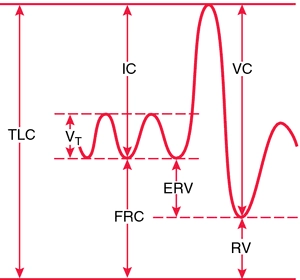
Subdivisions of total lung capacity: TLC, total lung capacity;V, tidal volume;
IC, inspiratory capacity; FRC, functionalresidual capacity;
ERV, expiratory reserve volume; VC, vitalcapacity; RV, residual volume.
Some of the air in the lungs does not participate in gas exchange. Such air is located in the anatomical dead space within bronchi and bronchioles—that is, outside the alveoli.